AI Agents & Software Jobs
Why AI Agents Will Replace Traditional Software Jobs (And What You Should Learn Next)
AI agents are transforming software engineering by automating coding, testing, debugging, and deployment. Discover which software jobs are changing, the skills developers need to stay competitive, and why AI will reshape the future of software engineering instead of replacing developers.
Artificial intelligence is changing software development faster than ever before. What started as AI-powered code suggestions has evolved into AI agents that can write code, fix bugs, run tests, deploy applications, and even monitor software with very little human input.
“The impact of AI Agents & Software Jobs is becoming clear as developers increasingly use AI throughout the software development process.”
This shift is already happening. According to the 2025 Stack Overflow Developer Survey, 84% of developers either use or plan to use AI tools, and 51% of professional developers use AI in their daily work. AI is no longer a tool for early adopters—it has become part of the modern software development process.
Why AI Agents Will Take Over Traditional Software Jobs (And What Skills You Need To Acquire Next)
AI agents are revolutionizing software engineering through automation of coding, testing, debugging, and deploying. Find out what software jobs are changing, skills that developers need to acquire in order to stay relevant, and why AI will revolutionize software engineering in the future and not replace developers.
Artificial intelligence is revolutionizing software development quicker than ever. The technology that used to offer developers only assistance in form of code suggestions has advanced into AI agents capable of writing code, fixing bugs, testing code, deploying applications, and monitoring software with minimal human involvement.
It is happening already. As per the 2025 Stack Overflow Developer Survey, 84% of developers either use AI tools or plan to start using them, and 51% of professional developers already utilize AI technology on a daily basis. AI is no longer an exclusive feature for early adopters; it is a regular practice in software engineering
Automation of jobs that involve coding and predictable activities is happening today, yet, there is an increasing need for engineers that can design and develop new systems and use artificial intelligence to find solutions for difficult situations.
Engineers should get ready for this challenge rather than be afraid of changes. Engineers that learn to use AI to increase their productivity and acquire necessary skills are the ones that will stay in demand in the future.
What Is an AI Agent?
This development is changing AI Agents & Software Jobs by automating more technical and repetitive tasks.”
While coding assistants answer users’ commands, the AI agents can reach certain goals without any involvement from humans.
Unlike coding assistants that just generate code, an AI agent plans activities, makes decisions, uses development tools, executes workflows, evaluates outcomes, and improves its actions until the goal is achieved.
Thus, when the coding assistant generates code according to your instructions, an AI agent can do much more.
The AI agent knows the structure of the entire project, can develop all necessary backend APIs, connect the frontend to the database, develop test cases, fix compilation issues, update documentation, and even prepare the app for deployment.
The automation of jobs associated with coding and predictable tasks is going on now, but there is a constant need for engineers who will be able to design and create new systems and use artificial intelligence to solve tough problems.
Engineers must get prepared for this challenge instead of being afraid of changes. Engineers who learn how to use AI to boost their productivity and skills will remain in demand in the future.
What Is an AI Agent?
Whereas coding assistants respond to users’ requests by creating code, the AI agents can accomplish their goals autonomously, without the help of humans.
In contrast to the coding assistants who simply write code, the AI agents plan activities, make decisions, utilize development tools, execute workflow, evaluate results, and refine its activities until the goal is accomplished.
Therefore, whereas the coding assistant creates code based on your requests, the AI agent can do much more.
The AI agent knows about the architecture of the whole project, creates backend APIs, connects the frontend with the database, develops test cases, compiles code, updates documentation, and even prepares the app for deployment.
Why Traditional Software Engineerings Jobs are Shifting
For decades, software development involved doing repetitive activities. Software engineers have spent hours writing boilerplate code, solving common problems, updating documentation, writing unit tests, reviewing pull requests and maintaining existing applications.
AI agents are particularly good at repetitive tasks in software development. They are able to generate code, solve common problems, write tests, review pull requests, update documentation, and perform automations faster than humans.
Research conducted by GitHub shows that around 46% of developers’ code is now AI-generated and this number could grow up to 60% in 2026. Instead of replacing developers, companies are relying on AI to do the repetitive tasks so engineers could concentrate on the bigger issues.
In today’s development world powered by AI technologies, we can get the following capabilities in one click:
- Generating application code
- Identifying and fixing common bugs
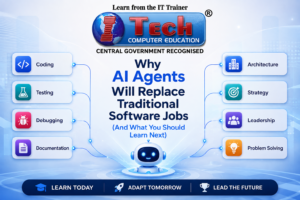
- Writing unit and integration tests
- Explaining codebases
- Generating documentation
- Code refactoring
- Pull request reviews
- Automating deployment pipelinesThe capabilities mentioned above allow businesses to complete the routine development process significantly faster.It does not necessarily mean that there will be fewer software projects. Rather, organizations are able to produce many more products with smaller development teams, which leads to greater requirements for the engineers’ productivity. Now engineers are not valued only because of coding but also problem-solving skills and ability to manage the intelligent systems.Organizations are adopting autonomous development environments, and now we see platforms specifically designed for AI-powered software development. Please read Google Antigravity 2.0: The AI Agent Platform Developers Are Watching.
Which Software Roles Are Prone to Change?
All software roles are not equally susceptible to automation. Software positions involving routine tasks will change faster.1. Junior Software DevelopersJunior developers tend to focus on fixing bugs, adding standard functionalities, turning designs into code or creating CRUD functionalities. It is precisely these tasks that are done well by AI agents.It does not mean that junior developers will be no longer needed. However, there will be an expectation from companies that new hires should be able to contribute at a higher level by understanding the architecture, reviewing the code generated by AI agents and solving business problems.2. Manual QA Engineers
The trend is toward automation in testing.AI agents can generate test scenarios, conduct regression testing, find edge cases and even offer solutions for test cases failing. While manual testing is needed to ensure usability, accessibility and exploratory testing, repetitive tasks in testing become more and more automated.
3. Support and Maintenance Engineers
Companies have many legacy systems that require constant but routine updates. AI agents can analyze logs, detect failures, recommend fixes and create patches.
4. Documentation Roles
Documentation generally falls into well-known patterns. Nowadays, AI is capable of producing API documentation, onboarding manuals, release notes, and code documentation with high precision, enabling technical writers to concentrate on editing and improving the produced materials instead of creating them from scratch.
The Software Jobs That Are Not Threatened by AI Agents
Despite the fact that artificial intelligence can easily cope with any kind of routine tasks, it still lacks some qualities such as judgment, creativity, leadership, and decision-making. That is why some software jobs remain hard to automate due to these qualities.1. Software Architects
It is software architects’ responsibility to make decisions concerning system scalability, security, architecture, and maintenance. They analyze all technical aspects, consider the architecture within the context of the business objectives and predict the future of systems. Such actions require strategic thinking and experience which are beyond the capabilities of AI agents.
2. Product Engineers
Product engineers are the ones who understand customers’ needs and translate them into technical requirements. They find user problems, prioritize features, evaluate users’ feedback and work together with designers, developers and business people.
3. Cybersecurity Professionals Cybersecurity specialists are responsible for defending systems from ever-changing threats. The job entails researching security issues, predicting attacks, analyzing risks, and planning security measures. Since cyber threats are constantly evolving, human skills and critical thinking cannot be replaced. 4. Engineering Managers Engineering managers do not code; they manage teams. They inspire developers, solve conflicts, negotiate with stakeholders, prioritize projects, and make decisions necessary for keeping engineering work in line with business goals.
All these management tasks are highly dependent on communication skills, emotional intelligence, and human resource management.
The future of software engineering will go to the specialists combining technical knowledge with critical thinking, teamwork, business acumen, and cooperation with AI agents.
What Skills You Should Learn to Stay Competitive
The biggest blunder for developers to commit is to concentrate solely on programming languages.Programming languages become obsolete over time, whereas problem-solving and systems thinking are relevant forever.
Developers should enhance their skills in several important domains in order to remain relevant in the era of artificial intelligence.
For those who wish to apply AI beyond software engineering, there is the Generative AI for Business program provided by The McCombs School. This training is oriented to business and functional leaders and includes such topics as building no-code AI workflows, recognizing valuable use cases of AI, and applying AI agents in practice.Secondly, developers need to expand their knowledge related to software architecture and system design since even though AI may generate code, developing an efficient, scalable and maintainable architecture requires human intervention.
Thirdly, mastering such skills as cloud computing and DevOps practices becomes increasingly relevant since modern software is more and more oriented towards cloud architecture, automatic deployment, monitoring and application containerization.
Moreover, it is also necessary for developers to familiarize themselves with such technologies as AI frameworks and APIs, RAG, MCP and multi-agent architectures as they are rapidly gaining importance within enterprise software development. Free Getting Started with Agentic AI course provided by Great Learning Academy can serve as a good start before going deeper into more complex multi-agent architectures.
Soft skills are no less important.
Such skills as communication, stakeholder management, teamwork and understanding of business become more and more valuable as they are the domains which cannot easily be replaced by AI.
These will not be the best coders but rather those that will know how to use their engineering capabilities together with AI tools to get better results.Also for further learning, you may refer to the videos of Great Learning, including the Generative AI Full Course.
AI Tools Every Developer Should Learn
Learning how to work with AI development tools has turned out to be an important capability of software engineers. GitHub Copilot, Cursor, and Claude Code are some of these tools that help developers to generate code, navigate through large-scale projects and automate repetitive processes.With the rise of AI coding assistants in the field of modern software engineering, developers may practice their practical skills in our Free Claude Code Course, where we introduce the basics of working with Claude Code for AI-enabled software development.
Also for further learning, you may check the free courses for practicing AI prompting – Prompt Engineering for ChatGPT and ChatGPT for Coders courses at Great Learning Academy.
Not all the developers will end up winning, and it won’t be those who create the maximum code either. It will be those who will be able to merge their engineering skills with the use of artificial intelligence tools.
Additionally, you could check out Great Learning videos, such as Generative AI Full Course.
AI Tools Every Developer Should Know
Knowledge of the development tools in AI is fastly turning into a must-have skill for any software engineer. Such programs as GitHub Copilot, Cursor, and Claude Code will enable software engineers to develop code faster, understand huge codebases and automate repetitive actions.As the process of coding with AI assistant becomes integral in the world of software engineering, developers can hone their practical skills through Free Claude Code Course, which will teach basics of Claude Code usage in AI coding.
Developers interested in AI prompting practice could try out Prompt Engineering for ChatGPT and ChatGPT for Coders from Great Learning Academy for free.
Will AI replace Software Engineers altogether?
Very unlikely!Historically, every new wave of technological development has resulted in job transformation, not replacement.
High-level programming languages didn’t replace programmers.
Cloud computing didn’t replace infrastructure engineers.
Low-code platforms didn’t replace software developers.
The same way AI agents will not replace software engineering. AI agents will replace a whole lot of tedious engineering work.
The job of a software engineer is changing from writing all lines of code to creating smart systems, managing work done by AI agents, validating outputs, and solving complex business problems.
Developers who fail to recognize the role of AI agents in development will be finding themselves with outdated skills.
Those who take on AI will probably be much more productive than any previous generation of software engineers.
For software engineers wanting to learn more about AI, there is an opportunity to enroll into the AI for Software Development program at The McCombs School. Tailored for software professionals, the program helps develop full-stack AI applications with Generative and Agentic AI and grants a professional certificate after completion.
Also Read –Agentic AI: How AI Agents Are Reshaping the Future of Work
Final Remarks
Artificial intelligence agents are revolutionizing software development but are not taking over the jobs of software engineers. Instead, they are redefining what programmers do.The GitLab enterprise study for 2026 reports that 78% of companies reported increased efficiency among developers who use artificial intelligence agents, and 85% said that reviewing AI-generated code is harder than creating it.
Frequently Asked Questions(FAQ’s)
6. Do AI agents take the place of software developers?
AI agents are set to automate numerous programming tasks, and although they will be a great transformation to software development, software engineers who understand how to interact with AI agents will be highly sought after.7. What software engineer jobs will be impacted by AI?
Newbie development jobs, manual testing, repetitive maintenance work, and document-intensive jobs will be heavily impacted by AI agents.8. What skills must software engineers develop in 2026?
Software engineers need to develop skills such as AI literacy, systems designing, cloud computing, DevOps, AI agents creation, prompt engineering, cybersecurity, and communication skills.9. Is programming a good profession?
Programming continues to be a good career as long as software developers are knowledgeable about AI tools and can use them to increase their productivity.