
Cybersecurity Career in India 2026
How to Start a Cybersecurity Career in India 2026
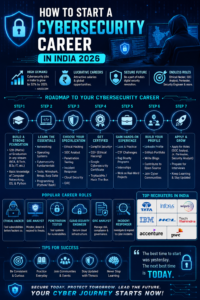
Five years ago, “cybersecurity” was a term most Indian job seekers associated with government agencies and defence organisations. Today, it is one of the fastest-growing and highest-paying career fields in the country, with demand that is outpacing supply at every level — from entry-level analysts to senior architects. Every company that operates online — which in 2026 means virtually every company — needs people who can protect its systems, data, and reputation from a constantly evolving landscape of threats.
Here is what makes cybersecurity genuinely exciting as a career choice right now: the talent gap is massive and real. India needs over 1.5 million cybersecurity professionals but the current skilled workforce falls dramatically short of that number. A motivated fresher who spends 6-9 months building the right skills, earning the right certifications, and practicing on real platforms can land a job paying Rs. 30,000-50,000 per month — and double that salary within two to three years. A mid-level professional with 3-4 years of experience and a strong specialisation can command Rs. 80,000-1,50,000 per month in top companies.
This is an all-encompassing and sincere guide to kick-start your cybersecurity career in India in 2026. This will provide information about every significant specialization, realistic salaries, skills required, how to get started without any experience, ideal certifications and how artificial intelligence is transforming the sector. No matter if you are a fresher or a working professional considering a change or an IT professional looking for specializations; you have got everything right here!
Why Cybersecurity is One of the Best Career Choices in India Right Now
India is one of the fastest-growing digital economies in the world. UPI transactions crossed 17,000 crore in 2025. Millions of businesses have moved their operations, customer data, and financial records online. The Indian government has digitised everything from tax filing to land records. And cybercriminals — individual hackers, organised crime groups, and state-sponsored actors — are attacking these systems every single day.
According to industry reports, India faces some of the highest volumes of cyberattacks in the Asia-Pacific region. Data breaches at banks, hospitals, e-commerce platforms, and government departments make headlines regularly. Companies have learned — often the hard way — that not investing in cybersecurity is far more expensive than investing in it. This urgency has created a hiring environment unlike almost any other IT field.
In addition to employment opportunities, cybersecurity offers various factors that make it very desirable:
High entrance barrier for attackers but low entrance barrier for students – The field favors curiosity and practical experience rather than expensive degrees High and steady salary growth – Even an entry-level position pays much better than other IT jobs High job security – There is no automation or outsourcing of cybersecurity jobs International demand – Indian cybersecurity specialists are needed in the US, the UK, the Middle East, and Singapore Hybrid and remote work – Most cybersecurity jobs can be done remotely Continuous development – The field changes daily and thus remains very interesting to those who like learning
Cybersecurity Specializations: Where Can You Go?
Cybersecurity is not just one discipline; it includes many disciplines that fall under the umbrella term “cybersecurity”. Having knowledge of the different paths will help you determine where to focus based on your abilities and preferences.
Security Operations/SOC Analysis
The SOC is the heart of a company’s cybersecurity operation. SOC analysts look out for cyber-attacks on the network and system of the organization round-the-clock and deal with the same in case they arise. This is the most common way for one to enter the cybersecurity profession in India since it teaches you hands-on experience in the shortest possible period since you are dealing with real threats.
Roles within SOC are divided into three categories: Level 1 analysts who carry out triaging of alerts, Level 2 analysts who investigate confirmed threats and Level 3 analysts who lead the process of incident response. The transition from Level 1 to Level 2 in 12-18 months is quite common for people motivated to progress their career.
People it will suit: Those who like the detective kind of role, can work under pressure and have no problem working in shifts or rotations.
Ethical Hacking and Penetration Testing
This term refers to hiring of hackers, popularly known as penetration testers or red teamers to hack into your system legally and to detect any vulnerabilities which might otherwise be exploited by the malicious attackers. This is one of the most interesting and lucrative job profiles in the field of cybersecurity.
Penetration testing is a structured process. It involves several steps such as reconnaissance, scanning, exploitation, post-exploitation, and reporting. The best penetration testers are also the best report writers since it is only through good reporting that the value of their services can be fully delivered to the business and technical management teams.
Who is it suited to? People who are curious and analytical and enjoy solving problems, reverse engineering, and learning continuously.
Network Security Engineering
Network security engineers design, build, and manage the secure network infrastructure used by organizations. This involves the setup and configuration of firewalls, VPNS, IDS/IPS, network segmentation, etc. For large enterprises, this is one of the highest paying and most advanced specialization fields within IT.
Who is it suited to? Experienced networking specialists who wish to specialize in securing infrastructure.
Cloud Security Engineering
Organizations are increasingly adopting AWS, Microsoft Azure, and Google Cloud as platforms on which to deploy their applications and computing workloads. There is thus an increasing need for experts who understand how to secure cloud environments. Cloud security engineering is currently one of the most demanded specializations in IT generally.
It is one of the highest paying jobs in the cybersecurity domain in India during 2026, with middle level employees earning Rs. 15,00,000 – 25,00,000 per year at leading firms.
What this is suitable for: IT experts who have some experience of working in cloud systems and would like to move towards cybersecurity, or cybersecurity experts who want to specialise in one of the most rapidly growing branches.
Governance, Risk and Compliance (GRC)
Contrary to popular belief not all cybersecurity jobs require skills in hacking or knowledge of infrastructure. Governance, risk and compliance analysts deal with policies, risk assessment, regulatory compliance and audit procedures. With the DPDP Act of India fully entering into force and businesses having to meet growing demands of compliance with standards like ISO 27001, SOC 2, and PCI-DSS, GRC has turned into an absolutely crucial specialisation and an especially lucrative one.
GRC is one of the most accessible specialisations for professionals without any technical background – legal experts, managers, financiers and auditors can become GRC analysts after obtaining proper certification.
What this is suitable for: analytical minds with good communication and documentation skills.
Application Security (AppSec)
Application Security experts collaborate with software developers in finding and addressing security weaknesses within the code and applications before their deployment — as well as detecting weaknesses within existing applications via code reviews and testing. AppSec is one of the fastest-growing specialties, considering how common “shift left” security and DevSecOps are becoming for Indian tech firms.
Ideal candidates: Individuals with a background in software development but looking to transition to the world of security.
Incident Response and Digital Forensics
Incident responders get involved after an actual breach or cyber-attack occurs. They mitigate the damage, investigate what took place, gather evidence and bring back systems to their regular operation. Digital forensics experts conduct investigation into the compromised systems and devices so as to find out what really happened there and gather evidence — skills that have become crucial in court cases of cybercrime.
Ideal candidates: Stress-proof individuals with an investigative streak and good communication skills.
Also read – Machine Learning Careers in India 2026: Jobs , Skills & Salary
Q1: Is cybersecurity a good career in India in 2026?
Yes – it is one of the best. There is huge demand for the professionals in the field, very high salaries in the field, there is excellent job security, and the field provides not only well-paid employment but also a good freelance/consultant career path.
Q2: Can I join the field of cybersecurity without engineering qualification?
Certainly, this is possible. Cybersecurity is mostly skill-oriented. BCA, B.Sc. holders, diploma holders, and even those who don’t have an IT background joined this field through certifications and self-study. It is important to showcase skills, a portfolio, and certifications. For the specialization of GRC, it is easy for professionals from law, management, and financial backgrounds to switch careers.
Q3: How much time will it take me to find a cybersecurity job?
With dedicated efforts – 2-3 hours daily – a person with an IT background can get ready for the job within 6-9 months. Non-IT background holder should prepare for 12-18 months.
Q4: Is cybersecurity impacted by AI? Will AI replace cybersecurity professionals?
AI is changing cybersecurity significantly — from both sides. Attackers are using AI to launch more sophisticated attacks faster. Defenders are using AI to detect threats earlier and respond more efficiently. This makes skilled cybersecurity professionals more valuable, not less — because AI systems still need human experts to tune them, interpret their outputs, investigate complex incidents, and make judgment calls in high-stakes situations